
📄 Evidence pack for needs assessors
PantryOK as assistive technology for ADHD task initiation
A reference document for workplace needs assessors, DSA needs assessors and occupational health practitioners evaluating whether this software is appropriate to recommend.
1Summary
PantryOK is a mobile application that provides structured support for initiating and completing everyday food-related tasks — shopping, cooking and eating — for adults whose executive function makes those tasks difficult to begin rather than difficult to understand.
The distinguishing mechanism is on-screen body doubling: the user selects the task they cannot start and the state they are in, and a recorded person begins that task alongside them, one step at a time, for the duration of the session. This is delivered alongside conventional executive-function supports — step decomposition, adjustable task size, timed sessions and external memory for kitchen state.
For assessment purposes the relevant point is that the software addresses initiation, which most organisational tools do not. A list, a reminder or a planner presupposes that the user can start once told what to do. Where initiation is the barrier, those tools accumulate unstarted items and can worsen the position.
2Support provided, mapped to assessment categories
| Support category | What the software does | Barrier addressed |
|---|---|---|
| Task initiation support | Guided sessions in which a recorded person performs the task alongside the user, advancing one step at a time. The user selects both the task and their current state. | Task paralysis and initiation failure, where the user knows what to do and cannot begin. |
| Executive-function scaffolding | Tasks decomposed into single ordered steps shown one at a time, with task size reducible to a single item when a full task is not achievable. | Working-memory load, sequencing difficulty, and the all-or-nothing pattern where a task not doable in full is not attempted at all. |
| Timed session support | The user commits to a planned duration before starting. The session runs against that estimate and both planned and actual minutes are recorded. | Time blindness, and open-ended tasks that are avoided because they have no visible endpoint. |
| External working memory | Items held as Have, Low or Need. Receipt scanning builds an itemised purchase history across more than 200 retail chains. | Prospective-memory failure at point of purchase, and repeat buying of items already held. |
| Reduced decision load | Suggests what can be prepared from items already present, rather than presenting an unconstrained choice. | Decision fatigue and the blank-page problem at the point a meal must be chosen. |
3How a session works
A typical supported shopping task proceeds as follows:
- The user opens the task and selects their current state from a fixed set: avoiding it, cannot start, no energy, or too much.
- The user chooses the size of the task — a single item, three items, or a full shop.
- The user sets a planned duration in minutes.
- The session begins. A recorded person performs the corresponding step on screen. The user's own list is shown alongside, so the guidance runs against their actual items rather than a generic demonstration.
- Steps advance in sequence until the task completes or the user ends the session.
- The session is written to the user's history with its planned duration, actual duration, item count and completion state.
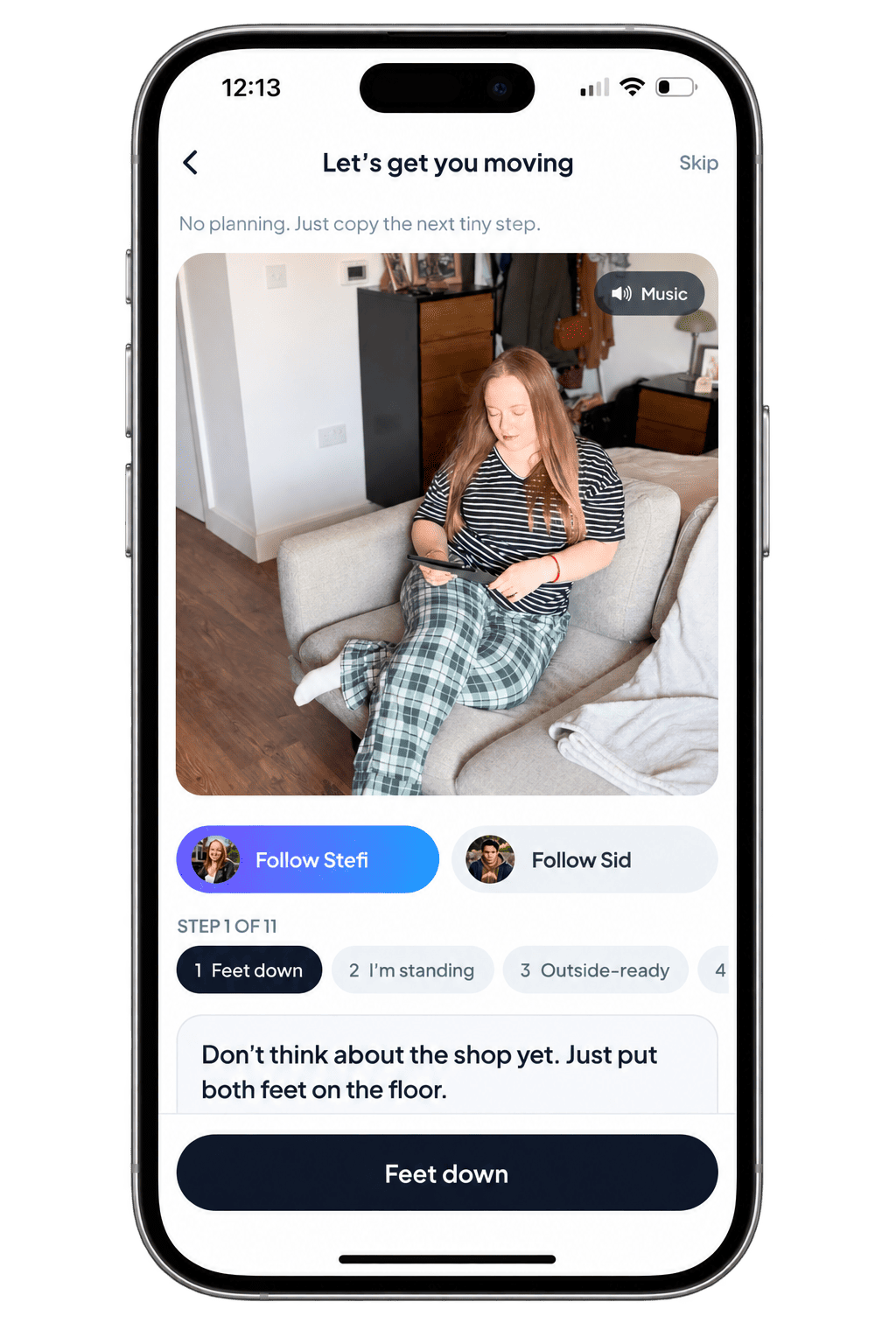
Distinct recorded sequences exist for each combination of task, state and task size, and the user can choose between two presenters. Sessions run without an internet connection to the assessor or employer; no third party observes them.
4Outcome data available at review
This is the section most relevant to a review decision
Every timed session is recorded with the minutes planned and the minutes actually taken. At an Access to Work or DSA review the user can present a session history rather than a subjective account of whether the support helped.
Each session record contains:
- Task type — shopping or cooking
- Planned duration in minutes, set by the user before starting
- Actual duration in seconds, measured
- Completion state — completed, or ended early
- For shopping sessions, items targeted against items obtained
- Date and time
This supports two review questions that are otherwise difficult to answer: whether the user is starting tasks they previously avoided, and whether their time estimation is improving. Both are visible as a trend across sessions rather than as a single self-report.
The data belongs to the user. It is theirs to share with an assessor or withhold; the supplier does not send reports to employers, assessors or the Department for Work and Pensions, and has no mechanism to do so.
5Research base for the method
Body doubling originated as a community practice among neurodivergent people and has only recently been studied formally. The literature is early and the study sizes are small. It is summarised here so that the method can be seen to have a research base, not to claim a clinical effect.
- Eagle, T., Baltaxe-Admony, L. B., and Ringland, K. E. (2024). “It Was Something I Naturally Found Worked and Heard About Later”: An Investigation of Body Doubling with Neurodivergent Participants. ACM Transactions on Accessible Computing, 17(3), pp. 1–30. A survey of 220 neurodivergent participants examining how, when and why body doubling is used, and how practitioners themselves define it. doi.org/10.1145/3689648
- Eagle, T., et al. (2023). Proposing Body Doubling as a Continuum of Space/Time and Mutuality: An Investigation with Neurodivergent Participants. Proceedings of the 25th International ACM SIGACCESS Conference on Computers and Accessibility (ASSETS ’23). Frames body doubling as a spectrum rather than a single practice, which is the model this software follows in offering recorded rather than live presence. doi.org/10.1145/3597638.3614486
- Ara, Z., Rahim, I. B., Zhou, P., Yu, L., Esmaeili, B., Yu, L.-F., and Hong, S. R. (2025). You Are Not Alone: Designing Body Doubling for ADHD in Virtual Reality. arXiv:2509.12153. In a controlled task with 12 participants, people completed the task faster and reported greater accuracy and sustained attention when working alongside a body double — whether a human or a simulated one — than when working alone. arxiv.org/abs/2509.12153
How this evidence should and should not be read
None of these studies tested PantryOK, and none establishes a clinical effect. They concern body doubling as a general strategy. The third finding is notable for this product because the benefit held with a simulated rather than live partner, which is the mode this software uses — but it is a single study with twelve participants and should be weighted accordingly. The evidence specific to an individual user is the session history described in section 4.
6Data protection and user control
- Data is stored per household with row-level access control; a user's records are not readable by other accounts.
- Session history, kitchen contents and purchase history are visible only to the account holder and any household members they have explicitly invited.
- There is no employer dashboard, assessor portal or reporting channel to any third party.
- Account and data deletion is available through a documented route at pantryok.com/delete-account.
- The privacy policy is published at pantryok.com/privacy.
Where an assessment requires a formal supplier assurance response — a DTAC submission, a security questionnaire, or an organisation's own procurement form — contact the supplier and it will be completed.
7Cost and procurement
| Plan | Annual cost | Appropriate where |
|---|---|---|
| Individual annual | $59.99 / year | One person. The default recommendation. |
| Family annual | $99.99 / year | A partner or household member is materially involved in how the tasks get done. |
Annual plans are recommended for funded users because Access to Work operates in annual award periods. Amounts are charged through the Apple App Store or Google Play in local currency; the figure shown at checkout is the amount paid.
Procurement sequence. A pro-forma invoice is issued as the quotation before purchase, generated at pantryok.com/access-to-work/invoice. Once support is approved, the applicant purchases in the app and the store receipt serves as the proof of purchase for the claim. A 14-day trial runs without a payment card, so suitability can be confirmed before any cost is committed.
8Scope and limitations
Stated plainly, so that a recommendation is not made on a mistaken basis:
- This is not a clinical intervention. PantryOK is a practical organisation and task-support app. It is not medical advice, diagnosis or ADHD treatment, and does not replace assessment, medication, therapy or coaching.
- The support is domestic in surface. The tasks are shopping, cooking and eating. Where an assessment is concerned strictly with tasks performed at a workplace, that connection has to be made explicitly — typically around sustaining working capacity across a day, and most directly for self-employed people.
- The body-double sequences are recorded, not live. There is no matching with another person and no scheduled appointment. Users who need live mutual accountability may be better served by a synchronous service.
- The research base is early. See section 5. No study has evaluated this product.
- Funding is not guaranteed. The supplier makes no representation about what any assessor or the Department for Work and Pensions will decide.
9Assessor contact
Free evaluation accounts are available to needs assessors and occupational health practitioners on request. The supplier can also provide a spec sheet in a required format, complete a procurement or security questionnaire, or arrange a walkthrough of the session flow.
Email support@pantryok.com with your organisation.
PantryOK is a practical organisation app. It is not medical advice, diagnosis, or ADHD treatment.
This document is a supplier's description of its own product, prepared for the use of needs assessors. It is not official government guidance and not a statement of any funding decision. Access to Work scheme rules, caps and eligibility change; the current position is published at gov.uk/access-to-work. Figures and citations in this document were checked in August 2026.
Published by Contour Integral AI Labs Limited, registered in England and Wales, company number 17154370. Registered office: Flat 103, 4 Barking Wharf Square, Barking, IG11 7DQ, United Kingdom · pantryok.com/access-to-work